How Cities and Counties Actually Manage Fleet Maintenance (and What Software Has to Prove)
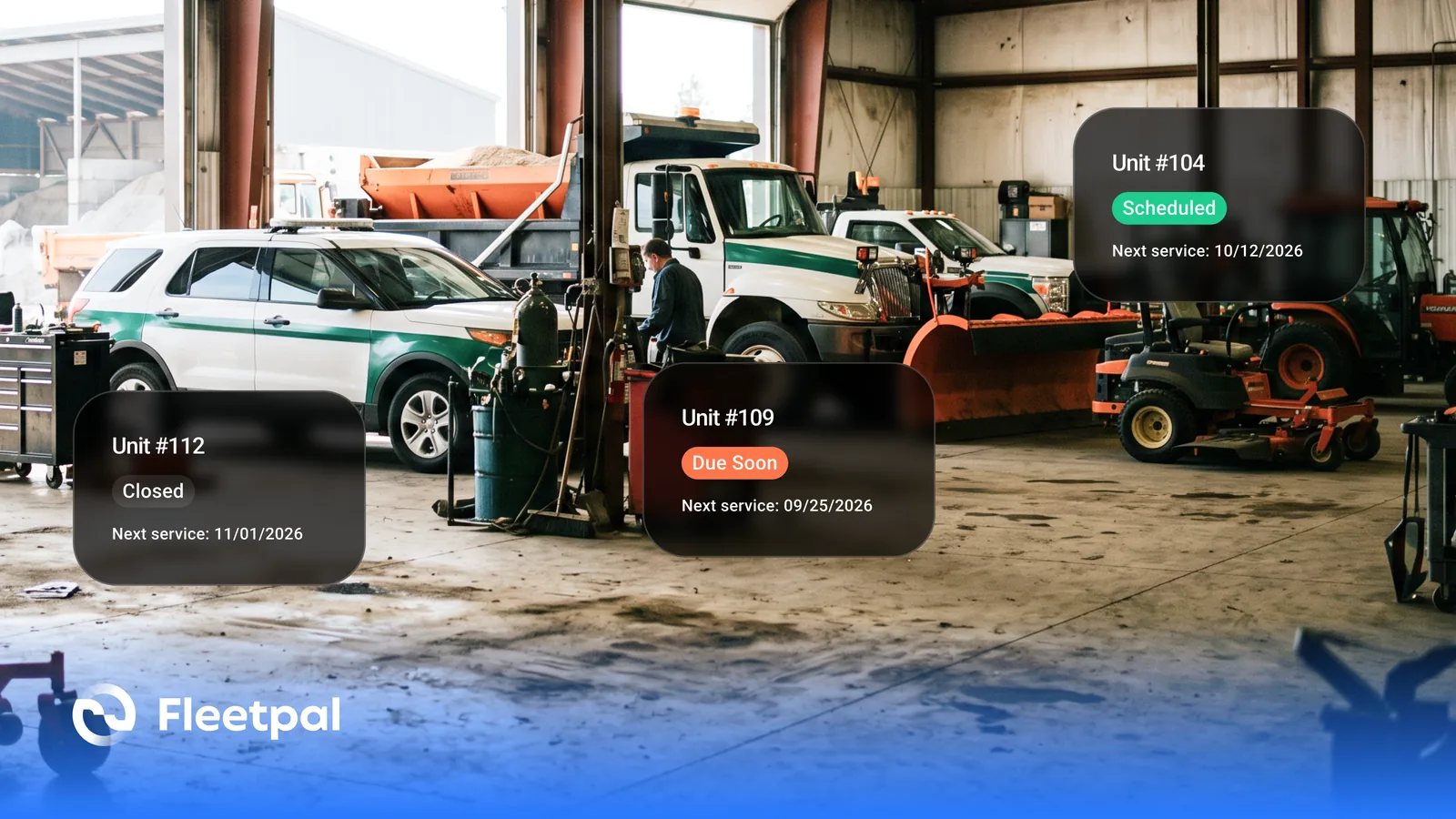
A public-works dump truck goes down on a Monday in February, in the middle of a snow event, with a hydraulic leak that three drivers had mentioned to three different people over the previous two weeks. The replacement for that truck was approved in principle two budget cycles ago and is still moving through procurement. The mechanic who could have caught the leak on a scheduled service never got the truck, because public works could not spare it, and nobody had a schedule that said it was due anyway. By Wednesday the finance director is asking why the repair invoice is what it is, and nobody can show her the approval.
None of the people in that story did anything wrong. The truck was old because replacements take years. The leak went unlogged because there was no single place to log it. The invoice surprised finance because the approval happened in a hallway. This is what fleet maintenance looks like in a lot of cities and counties, and it is not a competence problem. It is a records problem, and the records are the thing that eventually has to face an auditor, a council meeting, or a public-records request. Here is how public fleets that have this under control actually run, what software has to do to help, where it breaks, and what to ask any vendor who says their system was built for government.
How do cities and counties manage fleet maintenance?
The public fleets that run well are not the ones with the newest vehicles. They are the ones where four things are true at the same time. Every unit, whether it is a patrol car, a street sweeper, a fire apparatus, or a parks mower, has a maintenance schedule that fits how that unit is actually used. Every defect a driver finds lands somewhere a mechanic will see it, not on a sticky note on the key ring. Every dollar spent on a repair was approved by someone with the authority to approve it, before the work started, and that approval is on record. And every one of those facts lives in one place, per vehicle, so a question from finance or council can be answered by looking rather than by reconstructing.
That is the whole job. Government fleet maintenance software is maintenance software first and government software second: the same preventive maintenance, work orders, defect capture, vendor management, and per-unit reporting any heavy-duty fleet needs, with extra weight on approvals before spend, the audit trail, and reporting to people outside the shop. The guide to choosing fleet maintenance software covers the general evaluation; this article stays on what is specific to public fleets.
In Fleetpal, a municipal fleet lives in one system regardless of department: police, fire, public works, sanitation, parks, and admin vehicles each carry their own service history, their own preventive maintenance schedule, and their own cost record, and the shop works from one queue. The government fleet page covers the platform from the agency's side.
What breaks in practice: each department keeps its own list. Police tracks its units in a spreadsheet the fleet manager cannot see, public works has a whiteboard, parks has a binder, and the central shop has a work order pad. The fleet exists on paper as four fleets, and every cross-department question takes a week.
Ask the vendor: "Show me one screen with a patrol car, a plow truck, and a mower on it, each with its own next service due and its own year-to-date cost."
See where your fleet is losing money
Fleetpal brings inspections, work orders, and PM schedules into one system — so downtime stops catching you off guard. Book a 20-minute walkthrough.
Schedule a demoWhich vendors offer PM scheduling that enforces regulatory inspection intervals for municipal vehicle fleets?
Any vendor in this category will say yes to that question, so the useful version is what the scheduling has to do. The mistake most shops make when they inherit a multi-department fleet is putting everything on mileage. A patrol car accumulates engine hours while parked with the engine running and the lights on, and a mileage-based schedule will under-service it badly. A plow truck may sit for eight months and then run around the clock for a week. A parks mower has no odometer. A fire apparatus has a low mileage count and a set of inspection obligations that have nothing to do with miles. The category answer is preventive maintenance on the meter that matches the unit: mileage where mileage is the wear driver, engine hours where idle time is, and calendar intervals where neither applies. Regulatory inspection intervals belong in the third group: the annual inspection on a commercial unit, the periodic inspection on an aerial device or a fire pump, and whatever your state or agency requires on top, are due on a date whether or not the odometer moved, so they belong on a date-based interval that does not slide. One honest note on the word "enforces": software can put an overdue inspection in front of the right people and keep it there until it is done; it cannot make a department release the vehicle. Enforcement is policy. Visibility is the software's job.
The second part of the category answer is that the schedule has to be visible before the unit is overdue, and it has to be visible to the department that has to release the vehicle. A schedule the shop can see but the police sergeant cannot produces the same result as no schedule.
In Fleetpal, preventive maintenance intervals can trigger on mileage, on engine hours, or on a date, per asset, so the same fleet can run patrol cars on hours, plow trucks on a mix, mowers on a calendar, and annual inspections as date-based items that come due on schedule. Meter readings can sync from the telematics providers Fleetpal integrates with, so the schedule moves with the unit rather than with whoever remembered to enter a reading. The preventive maintenance page covers the scheduling model in full.
What breaks in practice: the one-size interval. Every unit on a 5,000-mile schedule, which means the idling units are chronically under-maintained and the low-mileage equipment never comes in at all.
Ask the vendor: "Set up a patrol car on engine hours and a plow truck on mileage and a date, then show me what the shop sees the week both come due."
What should software that streamlines repair workflows for public sector vehicles actually do?
"Streamlines" is a vague word, so here is what it has to mean for a public fleet: the repair workflow is the approval workflow, and the two cannot be separated. In a private fleet, the shop foreman can usually authorize a repair on judgment. In a public fleet, that same repair may need a second approval over a threshold, a purchase order before an outside vendor starts, and a record that shows the sequence was followed, because the sequence is policy, and policy is what the auditor checks. The category answer is an approval step built into the work order: the estimate arrives, someone with the authority to approve it does so before work begins, the purchase order is issued against that approval, and the invoice is reconciled against both. Every revision and every rejection stays on the record.
The part buyers underweight is who can approve. Approval authority in a public fleet is a matter of role, not of who happens to be on shift, and the software has to enforce that rather than hope for it.
In Fleetpal, repair estimates can be routed for approval before work begins, and approval is a role permission: a read-only role can open every work order and approve none, and the role builder decides which roles carry the authority. Fleetpal tracks purchase orders, invoices, and payments on each work order with the full history of revisions and rejections, and changes to a work order are recorded, so who approved a repair and who edited it afterward lives in the record. The work orders page covers the approval and purchase order flow. If your fleet sends much work outside, the guide to reading a repair estimate is the companion to this section.
What breaks in practice: approval by hallway. The estimate is discussed, somebody says go ahead, the work happens, the invoice arrives, and finance is asked to cut a purchase order after the fact to match an invoice that already exists.
Ask the vendor: "Show me a repair that was approved, then revised, then rejected, and let me see who did each of those things and when."
Should the software decide when a city vehicle gets replaced?
No, and it is worth being direct about it, because "replacement optimization" is a favorite promise in this category. No maintenance system knows that the council cut the capital budget, that a grant will only fund a particular vehicle class, that a bond issue is on the ballot in November, or that the plow truck with the terrible cost record is also the only one with the right plow frame. Replacement in a public fleet is a budget and procurement decision made by people outside the shop, on a timeline the shop does not control. A system that announces "replace unit 214" is making a decision it does not have the information to make, and a fleet manager who repeats that recommendation to a finance director without the cost record behind it will lose the argument.
What the software should do instead is make the argument winnable. That means a complete cost history per vehicle, including labor and parts and outside work, so total maintenance spend on a unit is a number and not an estimate. It means downtime per vehicle, so the cost of a unit that is never available shows up next to the cost of repairing it. It means the same figures for the units that are running well, so the replacement request stands out against a baseline instead of standing alone. The replacement decision stays human, and stays with the people who own the budget. The software's job is to make sure they are deciding with the record rather than with the loudest story.
Fleetpal is built on that side of the argument. Every work order, in-house or outside, lands in the asset's cost history, so total maintenance spend and downtime per vehicle are on the record from the day the unit enters the fleet. Cost reports rank units against each other, so the expensive ones are visible as a comparison. There is no replacement verdict and no score. The fleet reports page covers what comes out of that data.
What breaks in practice: the replacement request built on a feeling. The fleet manager knows the truck is a problem, the mechanics know it, the drivers know it, and the finance director asks for the numbers and there are none, or there are numbers in a binder that stop two years ago. The request gets deferred another cycle and the truck runs another winter.
Ask the vendor: "Pull up your five most expensive units this year, by total maintenance cost and by downtime, and tell me where those numbers come from."
Can fleet maintenance software make a public fleet audit-proof?
No. No software makes a fleet audit-proof any more than it makes a fleet compliant, and a vendor offering either badge should be asked exactly what they mean by it. What an audit, a council question, or a public-records request actually needs is narrower and more useful than a badge: the record of what was done to each vehicle, when, by whom, at what cost, and with whose approval, in a form that can be found and produced. Software cannot make the policy correct or the people follow it. It can make sure that when they do follow it, the evidence exists without anyone reconstructing it.
The category standard is that every record is created at the moment the event happens, by the person doing the work, and is never overwritten. The inspection is logged when the driver walks around the truck. The approval is logged when the approver clicks. The part is logged when it comes off the shelf. The invoice is attached when it arrives. An audit trail assembled at the end of the month from memory is a narrative, not a trail.
In Fleetpal, each asset carries a complete, searchable history of inspections, work orders, approvals, and costs, and every record is logged and exportable, so an audit or a public-records request is answered by filtering and exporting rather than by rebuilding. Changes to a work order are recorded, which is the part auditors ask about most. Whether a given record-keeping setup satisfies your agency's retention policy is a question for your records officer, not a software feature.
What breaks in practice: the records request that takes three weeks. The answer exists, spread across a work order pad, an email thread with the vendor, and a spreadsheet on one person's desktop, and assembling it becomes a project. The quieter failure is a record edited after the fact with no trace.
Ask the vendor: "Pick any unit. Give me everything done to it in the last twelve months, with approvals and costs, as an export, and show me whether any of those records were changed after they were created."
What should software that centralizes repair history for government vehicles actually do?
A centralized repair history means one record per vehicle that holds every job done to it, wherever it was done. The place that record usually breaks is outside work. Most public fleets send some share of their work outside: dealer-covered repairs, body work, specialty equipment like aerial devices and fire pumps, and overflow when the shop is full. The category answer is that outside work is a work order like any other. The estimate comes in, goes through the same approval, gets a purchase order, and lands in the same asset history at the same cost, so the vehicle's record does not have a hole in it every time it went across town. Vendor spend rolls up by vendor, so the fleet manager can see which shops get the work and what they charge for it.
The public-sector wrinkle is that vendor relationships are often contracts with terms, and the fleet needs to show that the work went to the contracted vendor at the contracted rate.
In Fleetpal, outside repairs are work orders assigned to a vendor, with the estimate, approval, purchase order, invoice, and payment tracked on the same record as in-house work. Spend rolls up by vendor, so the outside shops that cost the most and the ones that get the most work are visible as a comparison. The vendor management page covers the vendor side, and the utility fleet page covers the aerial-device and public-works overlap.
What breaks in practice: outside work living in accounts payable. The invoice is paid, the vehicle's maintenance history never hears about it, and the unit's cost record is missing every job it did not do in-house, which for some units is most of them.
Ask the vendor: "Show me a work order that went to an outside shop, and then show me that unit's total cost with and without the outside work."
How do drivers across departments report vehicle defects?
A city fleet has more kinds of drivers than almost any private fleet: sworn officers, seasonal parks staff, public-works crews on rotating equipment, volunteers on some fire departments, and staff who drive a pool car twice a month. Most of them will never open a maintenance app, and some will never have an account. The category answer has two parts. Drivers who inspect daily need a digital inspection that captures a photo, a location, and a description, and that puts the defect in a queue a mechanic owns. Everyone else needs a way to report a problem without an account or an app, which in practice means a code on the unit that opens a form.
The second part matters more in government than anywhere else, because the pool-car driver who notices the brake pull is the only person who will.
In Fleetpal, defects reported from inspections become tracked work orders, with the driver's photo and note carried into the job. Fleetpal Inspect, the inspection app, handles the capture side: drivers run digital DVIRs with photos and location, anyone can report a defect by scanning a QR code on the unit with no app and no login, and defects land in a triage queue where a person decides whether to open a work order, attach the defect to one already open, or record that no repair is needed. Fleetpal Inspect is free for qualified fleets, meaning 30 or more active power units in the US or Canada, after a short verification call; it is not a trial and it does not expire. The free tier is a standalone inspection tool; the sync into Fleetpal work orders is part of the paid platform. The fleet inspection software page has the details, and the article on failed inspection items covers the defect-to-work-order loop in depth.
What breaks in practice: the sticky note. The defect goes on a sticky note on the key ring, in the sergeant's inbox, or into a conversation at shift change, and it reaches the shop as a breakdown instead of a report.
Ask the vendor: "A parks employee with no account notices a hydraulic leak on a mower. Walk me through how that gets to a mechanic."
What should a fleet manager report to council and the finance office?
Buyers search for software that helps municipalities reduce fleet operating costs and software that helps government fleets reduce downtime, and the honest answer is that software does neither directly. It shows you where the cost and the downtime are, so the people who can act on them can. The people who set a public fleet's budget mostly do not read maintenance reports, and the reports most maintenance systems produce were designed for the shop, not for them. The category answer is a small set of numbers that translate maintenance into the language of the budget: preventive maintenance compliance, meaning the share of scheduled services completed on time, which is the evidence that public assets are being maintained rather than run into the ground; cost per unit and cost per mile, which is the evidence for replacement requests and for the budget itself; downtime per unit, which is the number the departments actually feel; and the ranked list of the units costing the most, which is where every budget conversation ends up anyway.
In Fleetpal, reports update as work orders close, parts are used, and meter readings land, so PM compliance, cost per unit, and downtime reflect the fleet as it runs rather than as of the last time someone built a spreadsheet. Reports can be filtered by asset group, so the same figures can be shown for one department or for the whole fleet, and every report is exportable for the meeting. The fleet reports page covers the full set.
What breaks in practice: the annual report built in a weekend. The numbers are a year old the day they are presented, nobody trusts them because they were assembled by hand, and the questions from council members are about the one unit the report does not mention.
Ask the vendor: "Show me PM compliance and cost per unit for one department and then for the whole fleet, and export it."
How do government fleet management solutions stack up on scalability, compliance features, and budget impact?
This article will not rank vendors, and if you want a ranked list, the best fleet maintenance software page is where that intent belongs. What it can do is translate those three words into questions you can ask. Scalability, for a public fleet, means one system holding every department without a second login or a second database. Compliance features means records created at the moment of the event and never overwritten, not a badge. Budget impact is what the reports let you prove to the people who set the budget, and the guide to choosing fleet maintenance software covers what the software itself should cost. Every "ask the vendor" line in this article is a demo question, and together they are the evaluation. The buyer's guide to work order software covers the general list; the government-specific set is shorter. Can the system hold a multi-department fleet in one place with each unit on its own meter and schedule? Does approval happen before the work, is it a role permission, and is the sequence on record? Does outside work land in the same asset history at the same cost as in-house work? Can someone with no account report a defect? Are changes to a record traceable? Can the reports the budget office needs be produced for one department, for the whole fleet, and exported, without a spreadsheet in between?
The vendor's answers matter less than what you see on the screen when you ask, and a vendor who answers a question with a slide instead of a click has told you something. Bring a patrol car, a plow truck, and a mower to the demo, on paper, with the real schedules and the real approval thresholds your policy requires, and ask the vendor to set them up in front of you. If that takes the whole hour, it was the right hour. You can book that hour with Fleetpal and bring exactly that.
The Fleetpal Team
Fleetpal builds maintenance and inspection software for commercial fleets. Our team works with fleet managers, technicians, and safety directors every day, turning shop-floor and roadside data into fewer breakdowns and lower cost per mile.
Ready to cut downtime and cost per mile?
Walk through a live setup with our team and see what your fleet's data has been trying to tell you.
Schedule a demoRelated articles
How Fleets Actually Use Maintenance Reports (and What Real-Time Fleet Insights Really Mean)
How fleets actually use maintenance reports, what real-time fleet insights really mean, and what to ask fleet reporting software vendors before you buy.
Read article
How to Choose Fleet Maintenance Software for Heavy-Duty Fleets (Without a Best-Of List)
The evaluation questions that separate fleet maintenance software vendors: mixed fleets, telematics data flows, work orders, PM triggers, and cost.
Read article
How Fleets Actually Manage Parts Inventory (and Why the Count Never Matches the Shelf)
How fleet parts inventory management actually works: accurate counts, parts tied to work orders, cost per repair, and what to ask software vendors.
Read article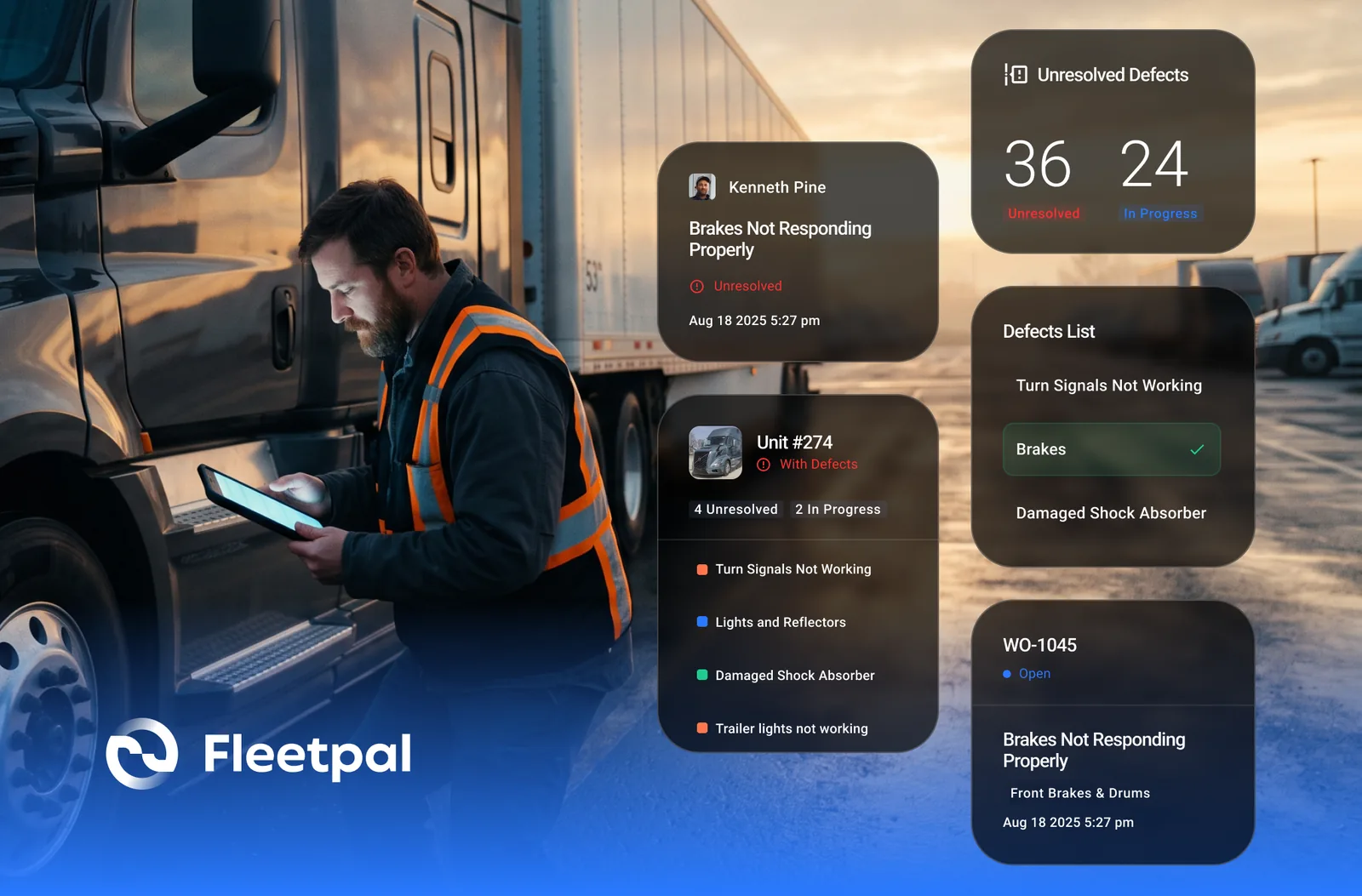
How Failed Inspection Items Become Work Orders (and Why Most Fleets Lose Them in Between)
Converting failed DVIR items into work orders: how the loop should run, where it breaks, and what to ask vendors who integrate inspections and work orders.
Read article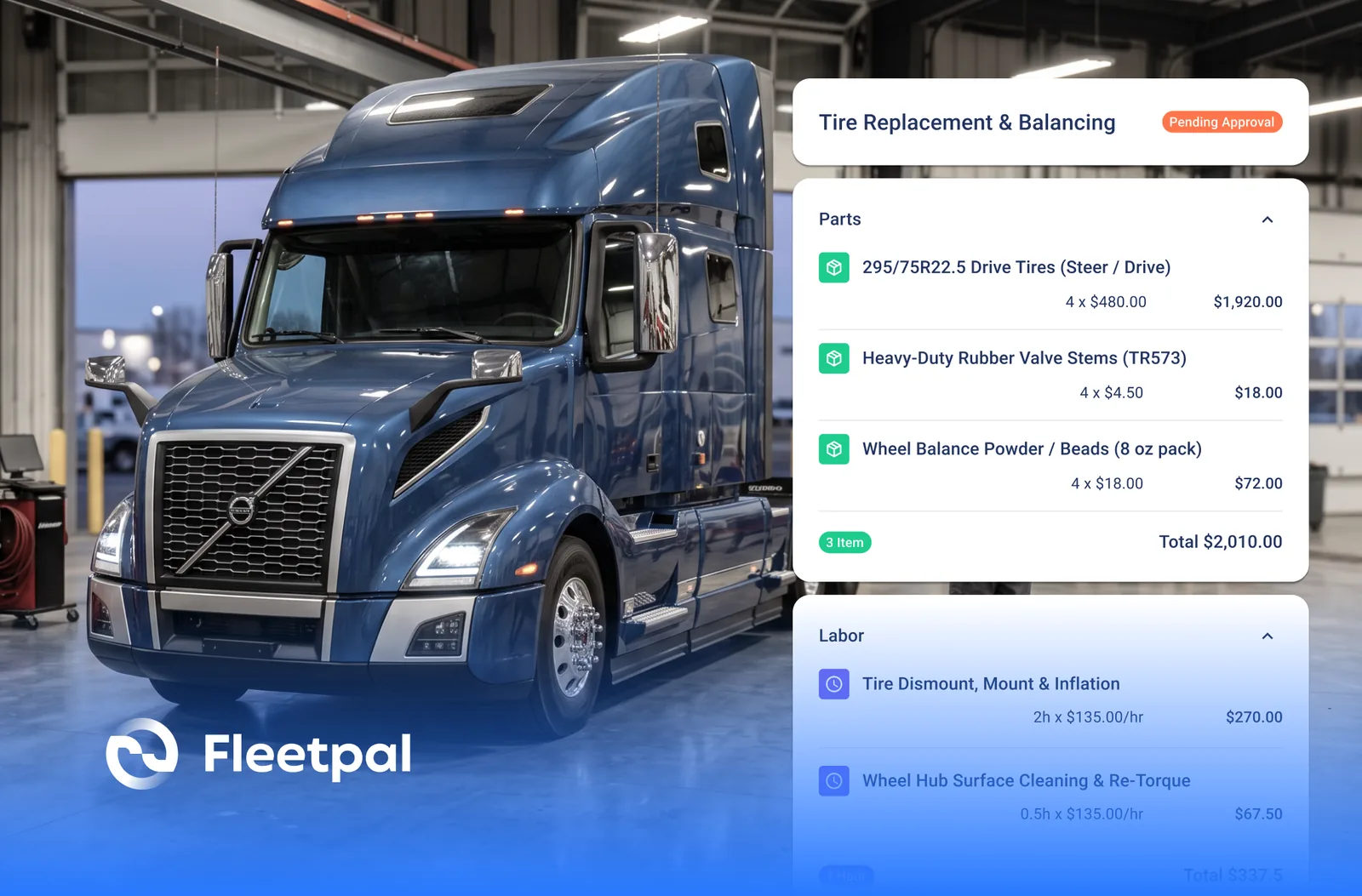
How to Spot an Inflated Repair Estimate Before You Approve It
Five red flags on a vendor repair estimate, how to baseline what a job should cost, and what to ask a vendor who claims to flag overpriced estimates.
Read article